| General Meeting Reports for 2026 | Return to Index |
| September 2026 | Keith Wong - Loudspeakers in Listening Rooms, Pt. II: Bass |
The 'Wizard' returned to the MAC stage for the
September GM. This time, Keith Wong tackled
the big and boomy topic of bass. When Keith
explained that this would be an even bigger
presentation to explain, I thought he was
joking. His first talk on treble was all about the
details of sound, how speaker position makes
a huge difference, and the behaviour of sound
waves in different spaces. Bass is often seen
as a big bottom end, with some loving it, and
others wanting it to be less intrusive. Surely,
bass was a simple thing to understand? Well,
as usual, I was wrong.
Keith again went into the details of how bass
behaves and how we might get bass to
behave. Bass makes up a third of perceived
sound quality. All recordings, even recordings
of violins, contain bass information. That is
where the soundstage lives. Keith highlighted
that the importance of bass is further
underlined by the fact that everybody,
regardless of age, can hear bass. But older
listeners are unable to hear frequencies above
12-15kHz, depending on how old you are.
Understanding the behaviour of bass was a big
part of Keith's talk. Of course, that means
going through some different graphs and
diagrams to better appreciate why single
solutions aren't a fix-all. Keith took us through
explanations of tonal tilt in how wavelengths
and bass frequencies function, especially in
rooms of different shapes and dimensions. For
higher frequencies, the frequency response is
dictated by the speaker. But for low
frequencies, it is a different kettle of fish. Bass
extension is a property of the speaker, but bass
linearity is a property of the room. If the bass
isn't controlled as well,
it will muddy and mask
the sound. He then took
us through simple
examples of step
response to see how
those tuning points
show how speakers
react when bass and
treble enter the room. It
was clear that the
interplay between the
speakers, the
subwoofer, the room,
and the listener all
factored into the final
experience.
Keith covered the
acoustic behaviour and
options of moving
speakers away from and
toward the wall. It was
surprising to learn that the 'golden ratio' of the
room and the 'rule of thirds' might not be so
'golden' after all, especially if we consider the
interaction of sound with different surfaces.
This led Keith to invite us to consider adding
more subwoofers to our listening rooms to
better manage and cancel out the bass waves.
Of course, adding 4 subwoofers might be a bit
of a stretch for some of us, but we appreciated
the reasons why!
One of Keith's favourite topics to point out is
that acoustic room treatment for low
frequencies is usually a fool's errand. This is
because such treatments have to be physically
massive and thus intrusive and expensive. They
also usually have other side effects, such as
inadvertently dampening high frequencies as
well, or are too narrow-band, meaning that
precise calculation and placement are
required. While the measurements show some
benefits, taming those frequencies below
80Hz can be challenging, even for very
expensive acoustic treatments! In simple
terms, the materials that sound interacts with
play a huge part. Which is why Keith
recommended that the most effective and
precise way to tame those low frequencies is
with multiple subwoofers and DSP. There are
several DSP solutions on the market, whether
you're a 'normie' or a 'nerd'. But remember:
with great power comes great responsibility -
make sure you know what you're doing!
Throughout the presentation, there were lots
of great questions from the 65 members in
attendance. Keith fielded each one with clear
explanations, as well as reminders of his
content from his first presentation. You can
access his slides from his first talk on treble
here: 'Loudspeakers in Listening Rooms - Part
I: Treble'. Keith's talk was another informative
and insightful experience; I think everyone
learnt something new about sound and home
audio.
Keith is a great example of a MAC member
who is passionate about sound and audio, is
keen to share his knowledge to help others,
and does so with patience and a great sense
of humour. Huge thanks again to Keith from all
of MAC for contributing to our Club.
For those keen to explore more, you can find
everything here -
https://tinyurl.com/3hjfface
, including the slides from
Keith's presentation, 'Room Equalisation
Wizard' (REW) - Full eBook and REW - Beginner's Guide
Arthur, a Melbourne-based audio engineer
and friend of the Club, presented his updated
Elektra Pnyx preamplifier, now o ered with the
convenience of a remote control. The Pnyx
(appropriately named after a hill where ancient
Athenians assembled to listen) is a balanced,
line-level, dual mono-designed valve preamp
based on the 6922 dual triode with an optional
MC/MM phono stage. The full system
presented for our listening pleasure included
the Elektra Reference HD power amplifier
(bipolar-junction-transistor-based, delivering
300W) and the compact and elegant
Brodmann Vienna Classic 2 speakers.
Rather than relying on o-the-shelf parts,
Arthur engineered the Pnyx strictly from the
ground up. Recognizing that power supply
noise is the Achilles' heel of traditional valve
amplifiers, he designed a profoundly quiet
preamp that simply lets the music breathe. The
secret lies in using a bank of red LEDs as an
ultra-stable voltage reference. An innovative
technique that provides vastly cleaner power
than standard valve power supplies. Operating
on this pristine power are four premium Electro-Harmonix 6922 valves, prized for their low
noise and minimal microphonics, driving a DC
coupled, fully-balanced circuit with true dual
mono power supplies.
We listened to a range of music from jazz to pop, vocals, and electronica.
The sound varied across different listening positions, but for those in the sweet spot towards the rear of the
Willis Room, it was obvious how revealing the system was of the music and recordings.
Coltrane's tenor sax on Miles
Davis' All Blues was focused, brassy, detailed,
and dynamic. Stacey Kent's vocal on Les eaux
de Mars was intimate, light, and open. The
soundstage filled out with the grainy warmth
of an alto saxophone floating above an
orchestral foundation on Karl Jenkins'
Stravaganza II. The electronic textures and the
fullness and projection of the soundstage on
Jean-Michel Jarre's Oxygene, Pt. 2 were
particularly impressive.
Arthur articulated his engineering philosophy
and passion for music through his final pre
amplifier design: a low-distortion, ultra-quiet
preamp that gets out of the way of the music.
It's that passion, science, and engineering that
are advancing the audio arts and reproducing
the emotion of music. All an audiophile can
ask for.
Tracks played:
Steely Dan - Home At Last
Contact the Editor for streaming playlists on Spotify, Tidal or Apple Music.
Andrew Daley
People were elected, stuff was bought, sold and swapped and food and drink consumed.
web Ed.
1. Conception & Project Objectives
The Camel II project originated from a
proposal by Damian Ware to design and
construct a high performance full range
loudspeaker. The primary objective was to
create a pair of reference quality loudspeakers
utilizing premium drivers and high grade
crossover components throughout. Upon
completion, the speakers were intended to
serve as his personal reference monitors.
During the initial design phase, several system
configurations were considered, including 3
way, 3.5-way and 4-way arrangements. The
final design brief called for a bass reflex
enclosure to handle the low frequencies and a
separate sealed enclosure housing the
midrange driver and tweeter. This approach
was chosen to for both optimal sound quality
and to allow for easier transport of the
cabinets during the project.
From the outset, the project emphasized
uncompromising performance, combining
carefully selected crossover components with
a resonant free cabinet design engineered to
deliver, accuracy and musicality.
August 2026
Arthur Rappos - Elektra Pnyx preamp
Miles Davis - All Blues
Stacey Kent - Les eaux de mars
Karl Jenkins (feat. Jess Gillam)
Stravaganza: Dreams & Drones
Yura Yunita - Duhai Sayang
Michael Jackson - Rock With You
Hiromi - Beethoven's Piano Sonata No.8
Jean-Michel Jarre - Oxygen, Pt. 2
Larry Carlton and Steve Lukather - Room 335
June 2026
AGM
May 2026
The Camel II Loudspeaker Project: A DIY Build & Test Report
2. Willis Room, the Ultimate Test
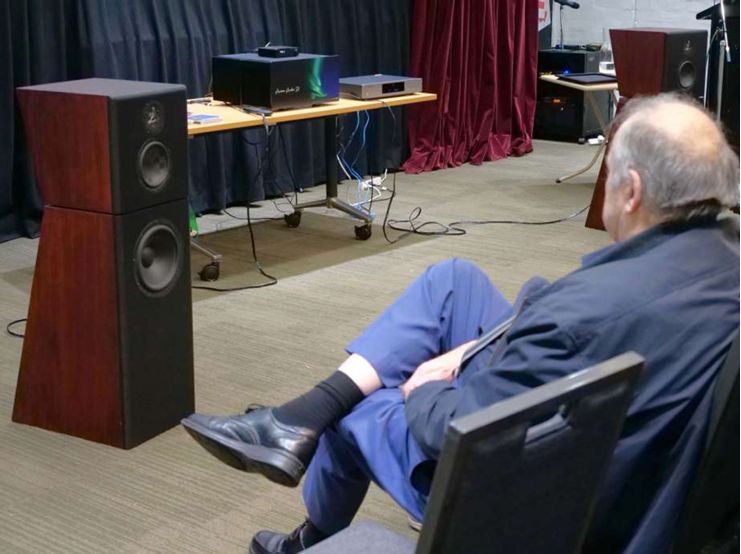
The Camel II speakers faced their ultimate test during a Melbourne Audio Club demonstration in the Willis Room. Paired with the superb Aurora Audio Signature 2x 70W Class A amplifier, SMSL D6-S DAC/preamp, and Arthur's Cambridge Audio CD player. This system, renowned for its e ortless power delivery, exceptional transparency and natural musicality provided the ideal opportunity to assess the Camel II performance under demanding listening conditions.
Members of the DIY group were impressed from the outset, noting that the speakers sounded excellent during setup. The positive reaction from club members reinforced the success of the Camel II project. Comments received from club members are presented below.
Michael D commented, "Having had glimpses into the design process, my expectations for the finalised Camel II were very high. Evaluated against my core priorities: tonality, resolution and dimensional staging, the Camel II delivered a performance that although different, impressed me as much as the active ATC SCM50 ASL we reviewed in 2020. The tonality is precisely balanced, offering a smooth, fatigue-free top end alongside an incredibly articulate, note-perfect bass response. The midrange is a standout, delivering exceptional clarity and natural timbre that allows for hours of effortless listening. When the recording allows, they throw an expansive, holographic 3D soundstage with precise imaging and space between instruments. From subtle micro-nuances to huge crescendos, the Camel II handles dynamics effortlessly without ever losing its superb detail. An awesome, musical speaker!"
Alan H commented, "Wow this system sounded better than any commercial high end systems I've ever heard in the Willis room, costing tens of thousands of dollars. The level of talent in the club's DIY group is incredible. You must be thrilled with the result."
Mak P commented, "The clarity was insane, with not the slightest hint of distortion even at higher listening levels. The presentation was exceptionally detailed, and effortless, making these speakers a genuine pleasure to listen to for extended periods. The synergy between the in speakers, amplifier, and DAC was outstanding, resulting a b a l a n c e d , coherent, and highly engaging musical sound. "
Derek L commented, "The speaker and amplifier sounded lucid, transparent and realistic with excellent bass and treble extension. It timed particularly well and was very engaging. The piano, with its complex combination of string harmonics, dynamic range, and resonant soundboard, is particularly challenging to reproduce accurately. Yet the Camel II system conveyed the texture of the strings and the rich, resonant character of the piano's body, resulting in an exceptionally realistic sound. Given the challenges of the Willis room and the full capacity it was at, this was an excellent achievement."
Philip N commented, "I thought the speakers sounded amazing! Great depth of sound from lows to highs. Beautiful tonality across many instruments' types including vocals. The low end is particularly good with an excellently tuned reflex cabinet. The Camel II impressed me so much that I've decided to build my Oval MK II using the same woofer as the Camel's. I suspect an amplifier upgrade may be next on the list!"
Dave P "Given the depth of knowledge and the development process of the Camel II speakers it is no wonder they easily match, and would probably exceed, the sound quality of any speaker I have heard ever. I truly loved listening to them whatever genre of music was played."
3. Driver Selection & Testing
The driver selection process for the Camel II project focused primarily on the midrange, as this band carries the majority of vocal and instrumental content.
A total of fourteen different midrange drivers, ranging from 4.5-inch to 7-inch units, were evaluated during this phase. Nine of the drivers that were evaluated were from the SB Acoustics range, as the manufacturers multiple different cone materials featuring the same motor design. The DIY group extends thanks to Richard S, who generously provided a wide selection of SB Acoustics midrange drivers for evaluation.
This stage of development was particularly rigorous. To ensure consistency and objectivity, a dedicated test enclosure was constructed, allowing each driver to be measured and auditioned under controlled conditions. Evaluation included blind listening sessions conducted by the group. The results had a correlation of approximately 80% between subjective impressions and objective measurements.
Following these comprehensive group evaluations, the following drivers were selected, a 10" Satori papyrus bass driver paired with a 6" Satori Textreme mid-range driver and a Satori Textreme tweeter.
4. Acoustic Parameters & Enclosure Design
With the physical drivers selected, the group set out to determine their precise Thiele/Small (T/S) parameters to establish baseline calculations for the enclosure volumes. While manufacturer-published specifications were readily available, the group opted to physically measure the drivers using both the ARTA and DATS measurement systems. Although the various design software programs and test systems yielded slightly di erent data, they provided the necessary parameters to finalize the internal enclosure volumes.
Once the volumes were established, the group turned to the visual and architectural design of the cabinets. The group heavily discussed the acoustic value of incorporating non-parallel faces to minimize internal standing waves. Sach Sackl, the group's architect, presented several unique design drawings. The group ultimately selected a form that established striking proportions and complex geometric angles in line with solid architectural and acoustic design principles. As well as a construction that the group could successfully fabricate.
5. Advanced Cabinet Construction
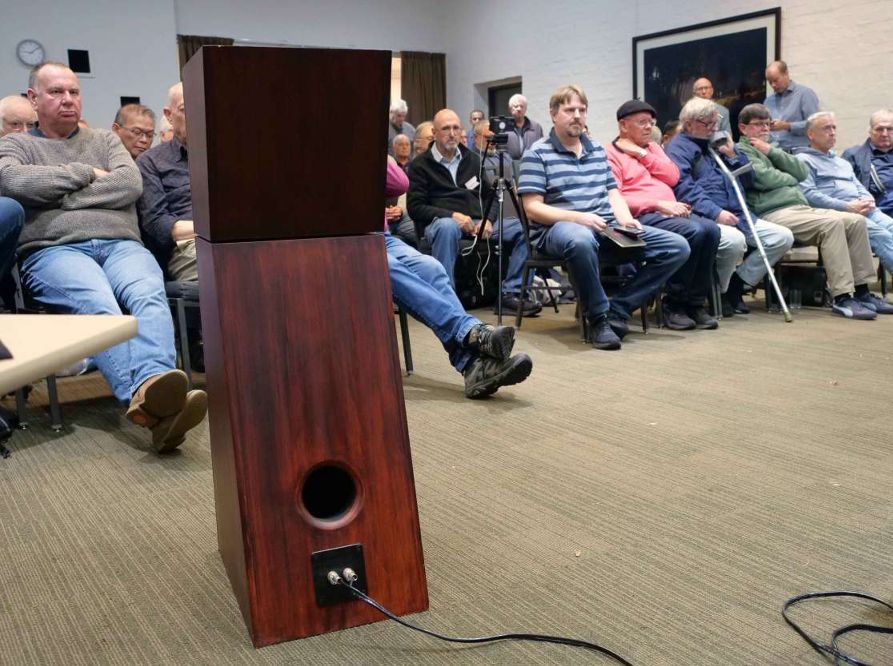
The physical execution of the cabinets introduced significant engineering challenges. The design called for complex 15-degree angled back panels on both enclosures, requiring highly accurate technical drawings. Stephen Myles provided the necessary computer drafting and CAD skills to resolve these layout requirements. phase involved evaluating various reflex port constructions alongside the strategic placement of internal damping materials to suppress unwanted mid-frequency energy from exiting the bass port.
To suppress cabinet wall radiation and internal resonances, the group implemented a heavy constrained-layer damping (CLD) panel topology. Stephen researched the implementation of this technique, locating online documentation from independent DIY builders who had experimented extensively with the concept. The front ba le with a total thickness of 37mm, comprised of 25mm MDF plus 12mm plywood. The rest of the cabinet consisted of composite panels, with a structure of a double-layer laminate of 12mm plywood and 12mm MDF. For the bass enclosure, the layers were laminated using a rigid PVA glue, while a non-resonant flooring glue was selected to bond the panels for the mid-range enclosure.
Constructing a double-walled enclosure featuring compound angles and non-parallel faces proved to be a challenging project compared to the standard, right-angled single-layer boxes typical of most loudspeaker construction. The build required numerous Saturday working bees alongside several extra construction sessions to complete. While high attendance meant that not everyone could physically work on the enclosures at one time, Ian Game was consistently on hand to assist with assembly. Crucially, navigating the demanding woodwork and complex joinery may not have been possible without Ron's extensive background and practical experience in woodworking and loudspeaker construction.
6.Tuning, Measurements, Crossover Refinement
Once the cabinet assembly was completed, the physical drivers were mounted into their respective enclosures so that acoustic testing and port tuning could begin. The initial testing The electrical crossover design was developed in two distinct stages. Initially, Ron engineered a series 1st-order crossover to handle the transition from the bass to the mid-range driver, paired with a 3rd-order network between the mid-range and the tweeter. Using his custom variable crossover test rig, Ron dialled in a solid baseline configuration that allowed the group to begin immediate listening tests and evaluate the initial system balance. With the speakers fully assembled, Phil Norman used his specialized turntable and test gear to capture comprehensive, high resolution o-axis acoustic measurements. This precise measurement data was then imported into VituixCAD simulation software. Ron, Damian and Stephen used these simulations to further refine and optimize the crossover network. Following the simulation updates, Damian spent extended sessions listening to the revised filters. Final listening tests and final adjustments were completed by the group with a wide variety of music.
7. Finishing & Final Presentation
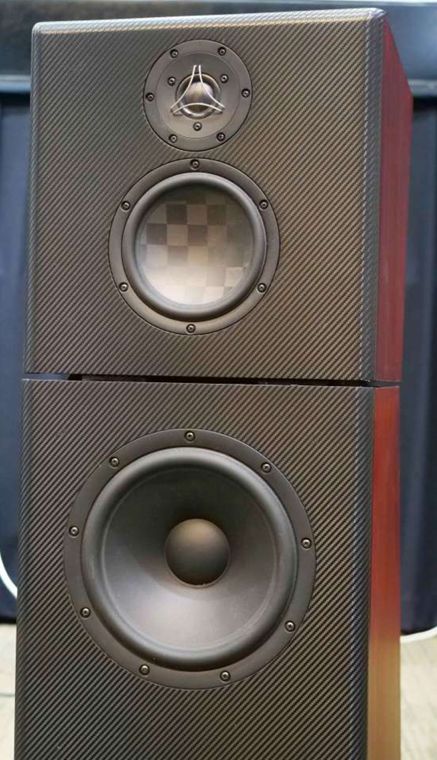
The final phase of the project focused on the aesthetic and cosmetic finishing of the enclosures. The exterior pine sections of the cabinets were sealed and stained in dark tones, while the front ba les were wrapped in a modern carbon fibre vinyl wrap. Custom grille covers were also fabricated to protect the face of the speakers.
The visual transformation was dramatic. The application of the darker stains and carbon fibre wrap completely changed the aesthetic character of the speaker, resulting in a premium, visually striking finish. Because of these darker tones, the large enclosures managed to visually "disappear" into the room environment while maintaining an elegant, high-end architectural presence.
MAC Audio Action/DIY Group
| April 2026 | A Songline for a Life, Part 2 |
The April monthly meeting saw the second
instalment of the idea put forward by Tony
Fisher late last year and first trialled at the
January meeting, when Tony and Bailey White
presented a collation of songs that had, for one
reason or another, played important parts in
their lives. It marked a significant innovation in
the structuring of the club's monthly meetings,
one that I supported strongly in my review in
the following MAN (see ? 606, February
2026). Last month it was the turn of David
Chambers and Matt Jelicich to give their spin
on the idea.
Dave tells me that he and Matt wanted the
night to be di erent from any gone before at a
monthly meeting: sustained audience
participation, giveaway lollies, a darkened and
more intimate space for listening, videos being
played as well as music, a quiz at the end, and
the night extending over a single session,
finishing at 9.30 pm. And indeed it was
di erent! Whereas Tony and Bailey's January
session was sequential, with Tony presenting
discourse (or was it 'discourteous'?) with
Henry Bolte, 38th premier of Victoria, was
priceless.
Matt captivated us with his description of
growing up in Auckland in the 1950s, and
enlivened that understanding by playing
snippets of what he heard on the radio at the
time. When I entered the Willis Room around
7:30 I was intrigued by what was hidden under
a tea towel in the middle of the stage, between
the two chairs. Matt, in a demonstration of
faultless timing and e ect, unveiled it to be the
ancient (but still working) valve radio his
parents owned in the 1950s and that he had
grown up listening too. He surprised us even
further by then revealing the very radio he had
as a teenager and an intriguing contraption
that not only played the radio but, by turning it
over, 45 rpm singles. Genius! If only all of our
presenters at monthly meetings could be so
clever, so thoughtful, so aware of the varied
needs of an audience to be educated and
entertained.
before the tea break and Bailey after it, Dave
and Matt took a di erent approach, playing
tag-team and alternating in their presentations
and choice of songs. They took Tony's
innovation of darkening the Willis Room for the
listening session one step further, having a
podium at the front with their chairs astride a
small table and on it a desk lamp, a bottle of
(alcohol-free) chardonnay to the side to
provide the necessary libations. Brilliant
stagemanship!
The presentations were masterful, not only in
the way Dave and Matt showed the
progression of their musical interests over the
past three, four, five, six, seven decades but
also in the way they captivated the audience.
Two lifetimes of musical interests were laid
bare, in the most honest and e ective and
entrancing way possible. Dave regaled us with
stories of a young life in Alexandra and Eildon
in north-eastern Victoria, his running a
restaurant there, and living with music all the
time. The names of a few old girlfriends
cropped up in conversation, something that
only added to the personal nature of the
presentation. His description of a brief
Although Dave and Matt dominated the show,
a number of other club members cannot remain
nameless in their contribution to its success.
Bailey was in the background, handling
e ortlessly the technology that stitched
everything together. It was quite an effort, as
Dave and Matt alternated in their presentations
and included snippets of selected tracks and,
in some cases, video clips to illustrate a
particular point. An analysis by a young female
singer, voice coach and YouTube sensation,
Lolli Wren (aka the Fairy Voice Mother), was
one such video. She undertook a thought
provoking analysis of the song 'Hocus Pocus'
by the 1970s Dutch prog-rock band Focus.
The lyrics go along the lines of:
"Joladadijoladadijoladadijoladadi
And I thought Little Richards'
"Awopbopaloobop Alopbamboom" was
meaningless. But then he didn't yodel them...
On the other hand, Chris Norton did attempt a
yodel (at Dave's invitation), much to the
delight and amusement of all.
Chris Mogford was the second noteworthy
assistant. Playing a role akin to that of Dugald
McAndrew in Rockwiz, Moggie dished out the
lollies to those in the audience who answered
correctly the many questions and points of
trivia posed throughout the night by Dave and
Matt.
Hugh was the third essential ingredient.
His Maya amplifier and custom-modified
speakers sounded magnificent on the night,
handling with aplomb tracks sung (or yodelled)
variously from Dean Martin to Thijs van Leer,
the Beatles to Marty Robbins, Leonard Cohen
to Gene Autry, even Yma Sumac for added
effect too.
So, to conclude, it was a superb iteration of
the idea proposed by Tony Fisher late last year.
I wouldn't want to have this type of session
every monthly meeting, but the two versions
we've had this year have been so successful
that the format must now be considered an
essential component of our annual program.
For once, we got to hear the personal stories
behind the choice of music, a case where the
music really DOES come first and the
equipment second. We get to learn a little bit
more about what makes our fellow members
tick, what their musical interests are, and how
those interests have evolved over time. And
often we get to learn something about the
music itself. Bravo.
And now to actually finish, with a concluding
observation. Dave and Matt started at around
7:45. They were finished by 9:30 or so (maybe
9:45 if we include the end-of-session quiz), as
they had planned. We then broke for tea. No
one died of thirst during the single,
uninterrupted session of around 2 hours. No
bladders were ruptured and urine spread
across the floor. No one looked constantly at
their watches or the ceiling or their shoes or
the fly on the wall, waiting in boredom for the
whole thing to draw to a merciful end when we
could all go home.
If we start promptly and
club business is dealt with e iciently at the
beginning, a single, uninterrupted sitting of
under 2 hours allows the presenter(s) ample
time to communicate what they want to say
and then provides an opportunity for attendees
to retreat out the back and chat over a cup of
tea, discuss what had just transpired, and
catch up with the presenter or with old friends.
These are the social and comradely elements of
the club, ones that in my view are just as
essential as the showcasing of specific items of
equipment.
Paul Boon
Our February meeting saw an excellent turnout, with many members eager to hear Doug's
Magneplanar speakers. Unfortunately, the speakers developed an issue with buzzing and
crackling and will require repair. We hope Ray will be able to assist Doug in restoring the
Maggies, and we look forward to featuring them at a future General Meeting later this year.
In place of Doug's system, Ray from HiFi Exchange presented a Dynaudio kit speaker. This was a
three-way design featuring dual midrange drivers in a D'Appolito MTM configuration,
complemented by a 10 inch woofer. The cabinets, built by John from Aranmar Acoustics, were
exceptionally solid and acoustically inert.
Ray also supplied supporting equipment, including a Consonance CD player, Audio Illusions
Modulus preamplifier, and a Marantz power amplifier.
The evening's music selection consisted of member-supplied CDs, with a focus on jazz and
classical genres as suggested by Ray. Many members contributed, thank you to everyone who
brought along their favourite selections.
Thank you Ray for providing the alternate system at short notice, we look forward to hearing the
Maggies.
Damian Ware
MAC President
Our February meeting featured an excellent presentation by Steve Mazurkiewicz from the
Australian Jazz Museum. Steve spoke about the digitisation and preservation of historic Australian
Jazz recordings.
Steve demonstrated the restoration process using a recording dating back to 1919. Showing how
modern techniques can remove artefacts such as clicks, pops, hiss, and background noise. The
comparison between the original recording and the restored version was remarkable and clearly
illustrated the value of this important preservation work. Thank you Steve for the excellent and
informative presentation.
Steve Mazurkiewicz, signed up as a new member and we warmly welcome him to the club. Please
take the opportunity to introduce yourself and make him feel welcome.
We would also like to extend our thanks to Alan Hull for kindly providing an audio system at very
short notice to support the presentation. Alan's exceptional battery powered amplifier and Dali
speakers provided great sound for the evening.
Damian Ware
MAC President
The inaugural monthly meeting for 2026 treated
MAC members to a new (and wonderful) type
of presentation in the Willis Room. For the first
time in living memory, two members presented
a personal selection of the music that was
important to them. In recent years we have had
some member-request nights and in pre-covid
times we enjoyed the occasional monthly
meeting dedicated to genres chosen by
convenors or committee. But never before
have we indulged an entire evening where two
members could expand on why particular
pieces of music were special to them. This is a
magnificent development, and no doubt that it
will add greatly to the diversity of
presentations throughout 2026. It is possible
too that this might be the first meeting review
authored by two reviewers.
The presentation was delivered, first by Tony and then Bailey. Each delivered a
'verbal caption' before each selection, and
words and music came together as a
description of long musical journeys across the
lives of two of our members. A Songline for a
Life, if you will. Tony began with the telling
point that, for a change, music rather than
equipment - or the sound produced by the
equipment - would be the defining feature of
the evening. Below are the pieces played
during the evening.
Tony's playlist was:
And Bailey's:
The equipment was a Denon PMA350Z power
amp (1980), DCM Time Windows transmission
line, floor-mount speakers (1979), and a WiiM
DAC streamer (2025), the first two contributed
by Ian Bouch, and the streamer owned by the
club. Critically, and again a worthwhile
innovation for a monthly meeting, the floor and
stage lights were dimmed with only a small
lamp on the lectern and at the rear of
auditorium. By this artifice we were obliged to
concentrate on the music and not on the
sound.
For once the tracks played did not draw heavily
on the old audiophile standards, things we've
heard ad nauseam during far too many other
presentations. If I (PIB) have to endure one
more playing during a monthly presentation of
Leonard Cohen's You Want It Darker or
Hallelujah, or Chris Jones' No Sanctuary or
Nick Cave's Red Right Hand, or anything o
Pink Floyd's 'Dark Side of the Moon', or Dire
Straits' 'Brothers in Arms', or the Eagles' 'Hotel
California', or anything by Diana Krall or Norah
Jones, I'll go even madder than I am currently.
For PIB, we were instead treated to a mix of
music we'd mostly never heard before (Tony's
selection) or trusty old favourites (Bailey's).
For HRD, much of the music - the Art
Garfunkel, Joni Mitchell, Little River Band, Elvis
Presley, Midnight Oil, Cold Chisel, Supertramp
- brought back wonderful memories and I
enjoyed them even more than when I first
heard them all those decades back. [Note from
PIB: see also the article in Headphonesty: '20
most over-used audiophile test albums that
need to retire in 2026', available at
https://www.headphonesty.com/2026/01/most-overused-audiophile-test-albums-need-retire/
As we are an audiophile club, this review must
address the vexed matter of sound quality. For
my own view (HRD), where sound quality has
always been a pivotal issue, I found the sound
only average, both in amp and speakers,
reflecting technical developments in the last 45
years. But oddly this did not detract from the
presentation at all raising important issues of
perception and reality. Your other reviewer
(PIB) thought quite di erently: I've loved the
DCM Time Windows from the moment I first
heard them (e.g. see my positive review of
them in issue 570 of the MAN, February 2023),
when they were used during the 2023
members' request night. I love the spatial
sense they create, even in a room as
acoustically as hideous as the Willis Room.
More and more, I feel that it is spatial 'reality'
that's most important in a speaker, not its
frequency response, its transient response or
even its lack of colouration. The sense of
'being there' that some speakers can conjure
out of thin air, even if only momentarily, is
magical to me. And I thought the DCMs' bass
was wonderful (again unusual in the wayward
Willis Room, and given the small size of the
bass-midrange drivers), the midrange
insightful, and the treble more than adequate.
Not bad, considering the speakers are, to be
kind, of only average build quality and their
drivers (Philips or Vifa) are far from state-of
the-art. To add this, HRD feels that a good
system creates a sense of engagement, and
this leads to emotional enjoyment of the music.
This system achieved this despite the technical
shortcomings. As regards the di erence in
conclusions between your two reviewers:
Viva la di erence!
The January presentation was trail-blazing in
many ways. It was set in low lighting, with only
a lectern dimly lit, and this added enormously
to the atmosphere, helping us concentrate on
the music rather than on the gear. The music,
mostly from the 1960s to the late 2000s,
aligned intimately with the lives of the two
presenters, giving an evocative mix of the
music, the lyrics, the history and significantly
the biographic information from the presenters.
They added their personal, subjective and
fascinating appraisal to each piece. This is a
very di erent presentation for the MAC and,
judging from the strong engagement of the
members we both saw at the end of the night,
we think it represents a seismic change for our
club and the members' enjoyment of the
monthly meetings.
We believe also that this presentation style has
opened a new, fruitful source for our
presenters and, significantly, draws directly
from the resources of our own members rather
than from invited retailers or distributors. It
adds versatility, as we have found over the
years that many outside presenters, and
particularly vendors, often go AWOL a week
before the event, throwing the club into a flat
spin. In the past we have focussed on the
equipment, with members concentrating on the
source, or the amplifier, or the speakers; this
audiophilia is obviously a major element of our
club, but in truth the club's real core is the
personalities and interactions and comradeship
of our members. In fact the socialising
preceding and following each monthly
demonstration where members sit and chat and
eagerly share experiences. This is for many of
us the most enjoyable aspects of our club
membership. The remarkable success of our
home meetings provides confirmation. The
January presentation demonstrated also that
we are all exceptionally interested in the music
journeys of our colleagues. Since we are no
longer young, these individual journeys are
often very, very interesting and highlight a
wide diversity of musical tastes and
experiences.
Hugh Dean & Paul Boon
Joladadijoladadi-jo-o-ooh
Joladadijoladadijoladadijoladadi
Joladadijoladadi-jo-o-ooh
Oooooh-oooooh-oooooh-oooooh".
March 2026
Hi-Fi Exchange
February 2026
Australian Jazz Museum
January 2026
A Songline for a Life