| General Meeting Reports for 2025 | Return to Index |
| December 2025 | December DIY Report |
This month we bring a collage of contributions
from David, Richard, Stephen and Dave. There are also some
static displays from Ron, Giscard, Mak, Alan and Alistair.
The first system for the night
consisted of an Audio Aero La Fontaine Music
Centre (provided by David), David's speakers and Richard's LJM L7
class AB MOSFET based power amplifier. The
second system the source was switched to
Dave's streamer plus DAC. The third
system was Stephen's Lintwikz Pluto
active speakers. All were quality products
produced by our own members.
Once again the club was spoilt with excellent
DIY products of an incredibly high standard.
We could easily have been fooled against retail
products rather than DIY.
The first system demonstrated excellent system
synergy, with Richard's amplifier
complementing David's speakers very well. The
twin 8-inch woofers delivered impressive bass
performance, easily coping with low organ
notes. When David played "You Do Something
to Me" by Anthony Warlow, the classic paper
cone sound, so familiar and loved by many
shone through. Wynton Marsalis's "The Flight
of the Bumblebee" highlighted the speaker's
mid range vifa P17 ultra light polypropylene
cone speed and dynamic capability. Revealing
a highly dynamic presentation, albeit with a
slight hint of harshness in the lower treble.
Overall, the speakers were very impressive in
the Willis Room, with superb build and finish
quality. They would fit perfectly in a high-end
retail showroom with a price tag to match. The
tonal balance was excellent and stands as a
true credit to the careful matching of the
drivers, cabinet design, and David's crossover
implementation.
Richard's power amplifier consisted of LJM L7
amplifier modules based on IRF MOSFET's, that
have been very popular in audio applications
for three decades. They have found their way
into many high end products, including several
of Nelson Pass's creations. The L7 modules
were sourced from ebay at a cost of $70.00
plus postage, RS toroidal transformer $284.00,
aluminium heatsinks and 2U aluminium case
from Altronics. The total build cost for the parts
was around $700. Richard remarked on the
issues he had to overcome with setting the bias
current and wiring. Richard's amplifier clearly
demonstrated that good sound can be had for
remarkably low cost with DIY. The amplifier has
plenty of power and e ortlessly drove David's
speakers. The mid range was accurate,
dynamic and detailed. The top end was
revealing and there was minimal distortion.
Excellent result for such a low cost that would
make a great first project.
David Dufin's comments.
At the 2025 'buy, swap and sell' I picked up a set
of speaker drivers previously owned by the late
member Greg Kerr. The drivers proved to have
been a fine choice by Greg.
Not being endowed with great cabinet building
skills I entrusted this job to John Woodhead of
Aranmar Acoustics Audio & Furniture
Manufacturers in Mentone. John has been building
cabinetry for ages and does a first class job. He
also has a computer program that can design a
suitable speaker box, all you have to do is give him
the parameters or the model of the drivers and the
program will do the rest. I took full advantage of
this service.
I had purchased a set of very cheap 3 way
crossovers on the Internet just to get the project
underway. The limitations of these crossovers were
immediately apparent. Back to the Internet where I
purchased some quite good quality copper caps
and inductors. With further refinement of the
component values I got a set of very decent
crossovers with crossover points of 300Hz and
4kHz. I was happy with the sound and this became
the final arrangement.
Fine tuning, I experimented a bit with damping
material. Acoustic foam did the job in the bass
reflex chamber and part of the contents of an old
cushion suited the midrange chamber. Our
speaker measurement expert, Ron Newbound, ran
his impedance measurement software over the
speakers and the results were textbook. It remains
for the MAC members to make up their minds
about the ultimate sound.
The drivers are as follows:
SCANSPEAK 21W/8556-01 woofers,( two per
cabinet).
VIFA P17WJ-00-08 midrange speakers.
SCANSPEAK D2604/830000 tweeters.
The speakers demonstrated at the December DIY
are now owned by Alan who was good
enough to allow my creations to be shown on the
night. Thanks Alan
As I wanted to showcase the sound of these
speakers at their best I bought along my Audio
Aero La Fontaine Music Centre together with DIY
AudioQuest Rocket 11 bi-wired speaker cables
and AudioQuest Evergreen LGC interconnects. The
amplifier on the night was a DIY creation built by
member Richard Struthers. Richards' amp did a
great job and I am very grateful to him for making
it available.
The initial test was done using the Toccata opening
from the CD "J S Bach Great Organ Works". To
say I was nervous about how the speakers would
sound in the Willis Room would be an
understatement as many a fine loudspeaker has
come to grief mainly thanks to bass resonances in
the room. After a brief listen It was obvious to me
that the Willis Room may have met its' match as
the sound of the organ filled the room and I didn't
detect any of the usual bass bloat I've experienced
on some occasions. Maybe I should have bought
along some of my favourite Wurlitzer CD's!
The large audience were subjected to music I like,
artists we heard were Anthony Warlow, The Cotton
Club Orchestra, Wynton Marsalis. Gershwin by
Grofe, Black and White Affair and Todd McKenny.
Thanks to all the members who said they liked my
attempt at speaker building and the sound on the
night. Flushed with this success I think I'll build
another set to demo next year.
The second system was based on the first
system, with the source changed to Dave
Polanske's streamer with an inbuilt DAC. The
streamer was built around a Raspberry Pi with a
"top-hat" DAC based on the ESS9023 DAC
chip. The software platform used was Volumio,
which supports TIDAL Connect.
On the night, something sounded slightly of
with limited volume and no top end, and Dave
noted that the system was not performing as
expected. See Dave's comments below for
further details. It is worth noting that the
Raspberry Pi platform is commonly used in
many retail streamers, as is the Volumio
software. In fact, it is not uncommon to find
$3k-$8k retail streamers using this exact
combination, albeit housed in a more elaborate
enclosure.
Even though there were issues on the night it's
important to recognise just how capable this
platform is. For anyone interested in building
their own streamer, this is an outstanding and
proven DIY solution that o ers remarkable
performance, flexibility, and value for money.
Damian
Dave's comments...
A few notes on my Raspberry Pi streamer I brought
along to the MAC DIY night:
Components used: Raspberry Pi 3B+,
Audiophonics ESS9023 DAC TOP HAT, Mean Well
5V power supply, case, switch and indicator lights
from Altronics
Construction and configuration:
I purchased a variable power supply from Altronics
as the Raspberry Pi needs a minimum of 5.1V. The
Raspberry Pi operating system is an image file that
needs to be etched onto a micro SD card. I went
with with Volumio as it offers TIDAL Connect and
Qobuz Connect, an excellent choice for a music
streamer.
Once powered up the challenge was to connect to
the WiFi, to my surprise it connected immediately
to Starlink in the house.
Once I knew the Raspberry Pi was working fine, I
turned my attention to the DAC board.
All initial settings are done through the Volumio
app after which I use the TIDAL connect feature
and remotely control the streamer through my
smartphone. The streamer can be connected via
wifi or Ethernet, for the DIY night it was using
Ethernet and fortuitously we have that capability on
the club's internet device.
I found the sound quality flat on the night. The
sound can be user-adjustable as there is capacity
within the DAC to set to a roll off for the top end
frequencies. The DAC outputs 2V and I had it set
at 500mV which limited the volume considerably. I
will look further into this as it would be useful for
anyone who wanted to build a streamer.
Dave Polanske
The third system of the evening was a fully
active setup, with all components supplied by
Stephen. The system comprised a
Raspberry Pi streamer, Topping D10S DAC,
and Linkwitz Pluto active speakers. The
speakers are semi-omnidirectional, employing
a 5-inch midrange driver that fires upward
toward the ceiling. The cost to build the
speakers is around $1,500. They can be used in
conjunction with a pair of 10 inch open ba le
subwoofers (designed for the Linkwitz LX mini),
the subwoofers were not used for the demo.
Physically, the speakers are compact, with
cabinets comprised of plumbing pipe sourced
from plumbing suppliers. While they may not
score highly on the wife approval factor, their
small size and light weight mean they can be
easily packed away when not in use.
On the night, the system was demonstrated
without the subwoofers, naturally limiting low
frequency extension. The top end is also
constrained due to the use of a 2-inch driver,
although this limitation lies beyond the hearing
range of many members. Furthermore the
speakers have limited maximum SPL and
cannot be played at high volumes. As Siegfried
Linkwitz himself commented regarding this
limitation: "just sit closer to the speakers."
Despite these constraints, the performance
was outstanding. Beethoven's Violin Sonata
and Alexander Melnikov, was remarkable. The
speakers completely disappeared, creating the
illusion that the piano was physically present in
the room. There was no hint of cabinet
resonance, and the tonal balance was
exceptionally natural.
Stephen concluded his presentation with
"Anything Goes" by Tony Bennett and Lady
Gaga. The upbeat rhythm and beautifully
reproduced vocals had the audience toe
tapping along to this modern interpretation of a
classic American swing jazz standard.
Taking all limitations into account, the
midrange performance of this system was
simply superb. The midrange was arguably the
best presented in recent years in the Willis
Room from any system, at any price.
History: Siegfried Linkwitz (1935-2018): The
original design appeared on Linkwitz web site in
2005 as a low cost DIY project. It is designed for
relatively close listening position in room, in larger
room it is advised to just add more distance behind
the listener.
I made an original version in 2008 purchasing
PCBs and construction notes from Mr. Linkwitz,
using a peerless paper base driver. In 2010 they
were updated version 2.1 using a seas 5 inch
aluminum base driver capable of greater
excursion allowing more base output along with
some new response EQ adjustments to the
electronics.
Details: The Pluto is Omni directional up to about
3 KHz then becoming directional at higher
frequencies up to about 15 KHz. The Omni
directional operation is as Linkwitz said
"illuminating the room uniformly over a very wide
frequency range; thus room reflections sound the
same as the direct sound, this helps creates a more
natural sound. Refer Linkwitz site Pluto introduction.
The vertically facing Base driver is mounted on a
rubber pipe coupler connected to 4 inch pressure
pipe. This makes an extremely rigid PVC sealed
enclosure with very little radiation from the walls. In
order to prevent pipe resonance the tube is filled
with a mix of polyester and teased out wool,
resulting in about 40dB return loss from end of
pipe reflections and additionally there is a notch in
the electronics to further reduce remaining half
wave pipe resonance.
The forward firing tweeter is an Aura 2 inch full
range open back driver. It is mounted in 2 inch
pipe positioning the tweeter over the base driver
and provides the enclosure for the tweeter. The
placement of Aura driver and Base driver results in
close time alignment of acoustic centers, an
additional all pass circuit corrects the phase shift
due the small offset in acoustic centers between
woofer and tweeter. This results in operation
something close to a point source.
Electronics The Pluto is an active 2 way speaker
and has separate amp for each driver.
It requires line input only, the analog electronic
crossover is 4th order Linkwitz Riley at a low 1 KHz.
Crossover and EQ is made using op-amps
Power amps are chip amps, 2x LM3886 in bridge
for the bass and a single LM3886 for the tweeter
Power supply has a low power 50 VA transformer
and 20,000uF capacitors on each supply rail
EQ for the base driver allows the small enclosure
to achieve -3db at about 40 Hz for the 2.1 version)
Limitations / compromises
Maximum volume is limited mostly by the drivers
that will overload when playing too loud.
No real tweeter, limited by the 2 inch driver so no
tweeter sparkle (not a problem to me)
No deep base limited by the 5 inch driver (still it
has surprising base for its size).
The Pluto has a unique look where form follows
function; it is an example of innovative and clever
design from Linkwitz with a spacious sound that's
hard to beat in an average sized room.
However I was concerned that they would be lost in
the Willis room's large space.
They probably sounded best at the front of the
room. In the Willis room they were working hard,
near their limits on demo, but still showed what
well designed small speaker can do.
When correctly positioned in a normal sized room
they have an ability to create a stable image and
seem to disappear.
Stephen
The Richard Allan speakers I brought along to
the December DIY meeting belong to my
brother's friend and they have been in a
cupboard for 50 years and are unused. I was
asked to assess whether they could be used in
a speaker project. I haven't done the testing
yet but I thought it would be good to bring
them along to show everyone what was
available to the Diyers back in the 70s.
Ron
SET 805 final stage amplifier. The timber board is a test bed for designing
valve circuits and has a variable 0 to 1,600 volt
DC power supply. Tube heaters are powered
by LiPo batteries. It currently has a single
stage, single ended 805 tube, with the tube's
heater currently powered by a battery, it's
electrically safe!
It has just three components, an input
transformer - the 805 triode tube - and an
output transformer. It can produce 50 watts
into an 8 ohm load of singled ended output,
when driven by a slave amplifier of 20 watts
output. The design & testing of this amplifier
was completed some time ago and it is now
under construction. The black vertical box is
the power supply, containing a full wave
rectified, three stage Cockroft-Walton power
supply outputting 850 volts DC (B+). The tube
heaters will be powered by the two 12.8V
60AH lithium batteries, that enable upto 15
hours of operation. The box itself is a modified
computer server cabinet, as these are well
made and cheap to buy.
The amplifier will be housed in the black
Hammond chassis from Canada, fabricated
from mild steel and recently milled by Speith
Engineering in Bayswater.
Damian Ware
The following is a summary of the items presented
at November's General Meeting, kindly supplied
by Ian Hooper.
Once again we thank Greg and Yvonne Osborn
for providing the wonderfully appropriate audio
equipment for the meeting. The Consonance
amplifier and disc player coupled by Greg's
custom made cables to a pair of Osborn
Epitome speakers. This system filled the Willis
Room with gorgeous sound. With "just the
right amount of detail."
The first two recordings were significant items
from my private collection and not for sale.
1. Walk Don't Run, The Ventures, a tune
copied by The Ventures in 1960 from the Chet
Atkins arrangement. The swing jazz tune was
written by Johnny "guitar" Smith. This record
inspired me to save money working at the
family farm, 8 miles north of Benalla, to buy a
red Top-40 Vibra-Twin electric guitar. So I
began my life and adventures in music and
technology. This is a story I would love to
share with the Club at a future meeting,
playing the appropriate tracks as we
progressed. I started preparing that program
but realized it would take too much time out of
tonight's program.
So, I will start with a short description of how
Fleetwood Mac came about. I will play their first big hit featuring the guitar skills of Peter
Green and Danny Kirwan. Both were severely
damaged by contaminated LSD at a party in
Germany when touring to support Fleetwood
Mac's first releases.
2. Albatross - Fleetwood Mac single.
November, 1968. From my private collection, a
hit world-wide. After this Fleetwood Mac
made 8 studio albums before the addition of
Lindsey Buckingham and Stevie Nicks. Mobile
Fidelity will release The Fleetwood Mac self
titled LP (also known as The White Album) on a
Limited Edition One-Step 180g double LP
(LMFUD1S 065) and a Ultra Dynamic Hybid
SACD (UDSACD 2311) later this year.
The following demonstrations are from Mobile
Fidelity Sound Laboratory
3. Mirage - Fleetwood Mac. (UDSACD 2283)
July 1982. The 13th studio album has 5 hit
singles, Hold Me, Gypsy, Love In Store, Oh
Diane, and Can't Go Back. I will skip through
these tracks 1, 2, 5, 9.10. Pick a track, any
track hit album.
4. Jagged Little Pill - Alanis Morissette.
(UDSACD 2281) "Post Grunge." Grammy
Winner for 5 Album of the Year awards, Best
Rock Album, Best Female Vocal, Best Female
Performance (You Oughta Know) Best Rock
Song and best Long Form Music Video. After
her promotion tour of the Pill album and
frequently performing the painful You Oughta
Know she sought treatment for PTSD.
5. Supposed Former Infatuation Junkie - Alanis
Morissette (UDSACD 2284) Show only.
6. Dangerous - Michael Jackson - (UDSACD
2289) The first 6 tracks are looped dance
grooves, interesting but tedious to my old ears.
Starting with track 7, Heal The World the rest
of the albums 14 tracks are pure art.
7. Listen To The Music - The Doobie Brothers -
(UDSACD 2041) The second Doobie Brothers
album is about to be released on a double 180
gram double 45rpm LP. When this was first
released I wore at least 2 cassettes out driving
around in my Hi-Ace Van. Another pick a track
any track great album.
8. Bookends - Simon and Garfunkel -
(UDSACD 2257) Show only. This is not really
a Simon and Garfunkel album, more like a
collection of out-takes, found sound pastiches,
and one Paul Simon song that featured in a
movie.
9. One Of These Nights - Eagles - (UDSACD
2232) Another pick a track any track, great
album. The outstanding track for me is the
story of Lyin' Eyes.
10. Prisoner in Disguise - Linda Ronstadt -
(UDCD 777 gold CD) This is scheduled to be
released as a double 45rpm LP.
11. No Secrets - Carly Simon - (UDSACD
2167) And yet, the track You'r So Vain has so
many secrets. A great recording from when the
world was young, with so many stars sitting in.
Soon to be released on double 45rpm LP.
12. Billy Joel - Piano Man - (UDSACD 2062)
A quality 1973 pop song who enjoyed a long
residency gig at Madison Square Garden in
New York from January 2014 to July 2024. The
music of Billy Joel was recently featured last
Friday 14th and Saturday 15th of November in a
show titled "Piano Man" by The Melbourne
Symphony Orchestra at Hamer Hall. For Billy
Joel fans Mobile Fidelity has remastered his
significant catalogue. Most of these
recordings have sold out and the last issue, the
Greatest Hits double SACD. Now selling for
handsome amounts.
13. Miles Davis - Sorcerer - (UDSACD 2145)
Show only. It has recently been released on
MFSL Super Vinyl.
14. Miles Davis - Bitches Brew - (UDSACD 2
2149) Show only. Soon to be released on
One Step vinyl.
15. Miles Davis - Sketches of Spain -
(UDSACD 2086) This has been released on
One Step vinyl.
16. Simon and Garfunkel - Parsley, Sage,
Rosemary & Thyme - (UDSACD 2199) - Show
only, This has been re-pressed on MFSL Super
Vinyl
17. Santana - Santana, Abraxas and
Caravanserai - (UDCD 773, UDSACD 2152 &
UDSACD2079) Show only. All of these titles
are being pressed again as single MFSL Super
Vinyl LPs.
We have not received any new classical
records this year. Besides, we no longer have
any quality classical music stores. So, we
explored our stock to find neglected back
catalogue masterpieces. We found these
fantastic SACDs from Cala Records. Cala
Records went into suspension several years
ago when Geo rey Simon, the CEO and Chief
Conductor, resigned to take a partnership with
his brother in their family trade building
developments, in the London Harbour precinct.
18. Granger: The Warriors - Melbourne
Symphony Orchestra, Geo rey Simon -
(CACDS 4033) An Aussie conducting an Ausie
orchestra performing Aussie compositions in an
Aussie town hall. Here presented on SACD.
There are only a few left.
19. Saint-Saens: Africa - London Philharmonic
Orchestra - Geo rey Simon - (CACDS 4031)
Show only. This could be three concerts on
one disc. It is exciting and dynamic.
20. Saint-Saens: Requiem & Organ Symphony - London Philharmonic Orchestra - Geo rey
Simon - (CACDS 4032) Recorded at All
Hallows Church, Gospel Oak, London with the
Grand Organ in Westminster Cathedral for the
symphony.
21. Ravel: Valley of the Bells - London
Philharmonic Orchestra - Geo rey Simon -
(CACDS 4026) Ravel's original work for piano
is here orchestrated by Percy Grainger for
orchestra and "any melodic percussion
instrument." The Piano Concerto in G and the
Five Popular Greek Melodies are also
absorbing.
In the 60s Geo rey studied with several of the
name conductors in Europe, but his biggest
influence was Leopold Stokowski. Like
Stokowski, Geo rey was more a "Showman"
and less a "Conductor." His freehand and
fluent style encouraged more passion from his
orchestras than the strict tone and tempo of his
contemporaries.
As always my sessions with the Melbourne Audio Club seem too short. Thank you all for listening and engaging.
Ian Hooper
At our October General Meeting, Russell &
Martin Lenehan from Lenehan Brothers
presented the System 1 loudspeakers with
Grandinote Supremo Integrated Amplifier
and the Grandinote Volta Streamer/DAC as
source. He used Foil Flex speaker cables and
XLR line level interconnects. The Grandinote
Supremo Amplifier is a mosfet Class A rated at
37W per channel. Unusually for a solid state
amplifier the Grandinote Supremo featured an
output transformer.
The System 1 is a premium two-way stand
mount loudspeaker designed for
uncompromising musical performance. The
System 1 features a SEAS Excel 19 cm
magnesium cone mid woofer paired with a
Morel 28 mm silk dome tweeter. The cabinet
construction is unique, crafted from solid
timber and reinforced internally with dual
metal layers. One of these layers is steel and
the other of aluminium; to achieve outstanding
rigidity and vibration control. The System 1
features a 3rd order crossover network set at 1.5
kHz. Despite their compact form, the System 1
loudspeakers are substantial in weight, tipping
the scales at 30 kg each, a testament to their
dense multilayer cabinet. Connection is
handled via ETI Research binding posts,
accommodating a wide range of high quality
speaker cables.
To support the substantial 30 kg weight of the
System 1 loudspeakers, Lenehen Brothers
provide a set of heavy duty stands. These
stands feature an innovative isolation system
that departs from traditional design
philosophies. Instead of rigidly coupling the
loudspeaker to the floor using spikes, the
October General Meeting Report
System 1 stands employ a flexible mounting
mechanism consisting of rubber and spring
elements. This design yields a resonant
frequency of approximately 2 Hz, providing
isolation from floor. When gently pushed, the
loudspeaker and stand assembly can be seen to
wobble slightly, a result of the very compliant
suspension system.
To further stabilise the
system and control any residual motion,
Lenehan Toppers (tuned mass dampers) are
placed atop each loudspeaker. These devices
are intended to counteract unwanted
movement while preserving isolation benefits.
This decoupled isolation approach runs
contrary to the long-standing convention of
rigid spike coupling, where loudspeakers are
mechanically rigidly coupled to the floor.
However, similar philosophies are now being
explored by companies such as IsoAcoustics,
suggesting a shift in thinking toward vibration
isolation rather than rigid coupling. Whether
this low-frequency compliant system provides a
superior sonic result remains a matter for the
listener's preference.
The System 1 loudspeaker represents quality
Australian craftsmanship, featuring locally
sourced hardwoods such as Ironbark and
Spotted Gum. This excellent loudspeakers
presents a rustic appearance with the warmth
and texture of real wood.
The playlist for the evening was presented by
Dave Polanske and Russell Lenehan and a link
to the full playlist can be found below. The
music began with Anette Askvik, 'Liberty', a
stellar recording featuring female vocals, piano,
cello and a superb Tenor Saxophone solo by
Petter Wettre. The Saxophone featuring an
exceptionally dark and breathy tone. The piano,
cello and saxophone were faithfully reproduced
without colouration and Anette's vocals were
clear, forward and without sibilance. Dave then
he played Nils Lofgren, (live acoustic) 'Keith
Don't Go'. This piece amazed with every micro
detail of the guitar strings, fingering and body
resonance, all rendered with precision. The
next song was Gojira, 'Drum Solo' playing the
lowest note B0, (approximately 30Hz). This
proved to be too demanding for the Seas Excel
mid woofer. Considering the size of the Willis
Room this was not unexpected and would
unlikely to be an issue if used in a small room.
After the break the members resumed their
seats to hear 'I'm Confessin' (That I Love You)
from Dean Martin's 'Dream with Dean' Album.
Dean's vocals provided a great centre image.
The evening ended the presentation with
Fleetwood Mac, The Chain. On this piece the
System 1 speakers and Grandinote Supermo
amplifier delivered a good performance.
Thank you to Russell and Martin Lenehan for
presenting the System 1 speakers and
Grandionote electronics. It was an unusual
combination, very Australian and Italian, and
delivered a very unusual experience for the
Club members.
Meeting playlist (Tidal): https://tidal.com/playlist/343c90ac-589c-45dd-8c25-744aec98f6ac
Damian Ware
At our September General Meeting, we had the
pleasure of an engaging and insightful
presentation by Cristian from Corsini Acoustic
Solutions. Cristian shared several real-world
examples of rooms he has treated, providing
detailed descriptions of both the system setups
and the acoustic treatments applied.
Cristian's presentation included before and after
photos and results, clearly illustrating the
impact of proper treatment on sound quality.
Some key takeaways from the session included:
System setup is critical: Speaker
positioning and the listener's placement in
the room can significantly influence sound
quality.
Active bass traps are particularly effective
in the 15-150Hz range, where traditional
passive solutions can be either ineffective
or require large and intrusive
constructions.
Christian also showcased a wide variety of
high-quality acoustic treatment products
that he has access to, offering valuable
insights into what's available for both
enthusiasts and professionals.
A big thank you to Christian for taking the time
to share his expertise and services with our
members!
Damian Ware
At our August General Meeting, Arthur Rappos
from Elektra Audio presented the Elektra HD2
Power amplifier and Brodmann F2 speakers.
The Elektra HD2 is a multichannel power
amplifier rated at 175W per channel into 8
ohms with 0.001% THD @100W. The
Brodmann F2 speakers featured 2 x 5" side
mounted drivers and 25mm front mounted
tweeter. The source for the evening was the
club's WiiM Pro Plus streaming Tidal.
The Elektra HD2 power amplifier presents a
classic aesthetic, featuring a minimalist front
panel with a single, blue illuminated power
button and a sleek black finish. Offering seven
channels of Class AB amplification; the unit is
remarkably compact. The Elektra HD2 is a
powerful addition to any high performance
home theatre or 2 channel system.
Paired with the Elektra HD2 amplifier were
Brodmann F2 loudspeakers. With a slim,
elegant form factor and high gloss piano black
finish these speaker exude sophistication.
Visually understated yet luxurious, the
Brodmann's deliver a design that blends
seamlessly into modern living rooms - easily
meeting the coveted "spouse approval factor."
Arthur provided an entertaining and sporadic
presentation, captivating the audience with
deep observations into technical design and
thought-provoking controversial topics. After
an overview of the equipment specifications, he
gave a detailed description of his approach to
amplifier design. Arthur's approach is
methodical, measured and uncompromising,
focused on faithful reproduction of the source.
Using accurate spice models Arthur uses
advanced circuit simulation tools to evaluate
his designs. Virtual prototyping enables
evaluation of distortion, precise tuning of
feedback networks and rock solid stability
before any physical circuit is built. The next
stage is PCB development followed by
mechanical integration and rigorous listening
tests.
The playlist for the evening was provided by
Dave Polanske, Bailey White and Arthur
Rappos, a link to the full playlist can be found
below. Starting with George Ezra's Budapest
George's crisp unique voice was faithfully
reproduced without colouration. Then he
played Handel's Apollo e Dafane, HWV 122 to
demonstrate the high dynamic range of the
system. The female vocals
were clear without sibilance,
building the emotional
tension. Steely Dan, Aja a
features sophisticated cords,
(typically used in jazz) with a
shifting rock time signature.
Aja was a delight, the
percussion was dynamic,
keyboard was accurate and
Wayne Shorter solo tenor
saxophone was unmistakable
dark, slightly raspy.Brilliant.
Rather than relying on rare
and boutique parts Arthur has
optimised his design to use
mass produced main stream
parts. These parts such as
Nippon Chemi-Con capacitors
have tight tolerances and are
extremely reliable. Mass
produced parts, are also
utilised from multiple
reputable international
suppliers, minimising part
chain supply issues and
reducing cost.
After the break the crowds returned to their
seats to hear Dead can Dance's, 'Rakim'. The
sound expansively filled the Willis room. With
an extensive mix of percussion, ambient
textures and layered electronic effects this track
is a complex test for any amplifier. The Elektra
HD2 was effortless, handling Rakim with ease.
The Brodmann speakers were superb in the
upper registers, but did show some signs of
stress with the deep notes, given the speakers
use 2 x 5" drivers and the size of the Willis
room the speakers exceeded expectations. In a
small living room or apartment the Bodmann
F2's (I would expect) the bass output would be
sufficient for most listeners.
Arthur didn't shy away from addressing some
of the more difficult topics and beliefs in the
audio industry. He explained that higher priced
products do not always correlate with better
performance and that the influence of 'Golden
Ears' in subjective evaluations was
problematic. Arthurs engineering based
comments were well received by the members
and lead to some lively discussion with
members relaying their own similar
experiences.
Ending the presentation with George Harrison,
My Sweet Lord the Elektra HD2 and Brodmann
F2's delivered both excellent performance and
timeless understated visual appeal, ideal for
listeners who value both sonic excellence and
design harmony.
Meeting playlist (Tidal): https://tidal.com/playlist/63afe7db-bfd8-4d4d-8b33-aafd44b9fa78
Damian Ware
At our July General Meeting, Kevin You from
Class A Audio presented the Boulder 866
Integrated amplifier and Audiovector Trapeze
RI speakers. The Boulder 866 has a built in
Roon Ready streamer, full colour touch screen
and internal DAC. The 2ch amplifier is rated at
200W per channel into 8 ohms, 0.01% THD
and 150kHz bandwidth.
The Audiovector Trapeze RI speakers are a
reimagining of the original Audiovector
Trapeze released in 1979. The Trapeze RI have
the same cabinet design as the originals using
completely new drivers, crossovers and
internal wiring. They featured a 12 inch woofer
with an internal 8 inch woofer in isobaric
configuration, 5 inch midrange and AMT
tweeter. The source for the evening was Qobuz
streaming via Roon.
The Boulder 866 had a classic appearance with
a silver finish. The colour touch screen wasn't
overstated and was a nice highlight. The front
panel was sloped back, with a matching look to
the sloped Trapeze RI speakers. The Trapeze
R1 feature a unique cabinet with a sloped front
baffle and multiple angles to eliminate internal
standing waves. The mid range and tweeter
were offset and had a section of sound
absorbing felt to reduce edge diffraction.
The cabinetry and finish of the Trapeze RI was
superb. It offered complicated angles, a
seamless finish, and a perfect woodgrain
alignment. Attention to detail was exceptional,
a credit to the creators.
After a concise explanation of the equipment
the audience was impressed with Stacey Kent's
La Valse Des Lilas. The tenor saxophone,
played by Jim Tomlinson, was smooth and
filled the room with a very large sound. Stacey's
vocals were dead centre slightly forward of the
speakers. Keven next played Simone
Kopmajer's Nothing's Gonna Change My Love
for You, and the system once again showed the
large sound as the speakers completely
disappeared.
Jacky Fung, the sales manager of Audiovector
for South Pacific, provided a demonstration of
the significant difference between the speed/
resistance of the commonly used aluminium vs
titanium former in the Trapeze RI. When
inserted into the motor structure the
aluminium former creates eddy currents that
increases resistance and reduces the speed at
which the voice coil can traverse. The titanium
former allowed the voice coil to be inserted
with no such resistance, bringing faster
transient response and better dynamics
particularly when listening at higher SPLs.
The benefit of the titanium former became
clear when listening to Leopold Stokowski &
July General Meeting Report
RCA Victor's Hungarian Rhapsody No. 2 in C
Sharp Minor, as the system revealed every
quiet micro detail whilst effortlessly hitting the
low notes.
The Boulder 866 demonstrated a high level of
driver
control with
tight and fast
percussion
with clean
decay with
Dacoit Duel
from A.R.
Rahman &
Matt
Dunkley.
Next Kevin
played
electronic
music - Francine Thirteen's
Queen Mary.
The system
was able to
demonstrate exceptional dynamics and very
high decibels in the large Willis Room. The
Boulder 866 had power to spare, sounded
effortless, and remained in complete control.
After the break the crowds returned to their
seats to the lovely Chantal Chamberland's La
vie en rose. The smooth warm female vocals
caught the attention of the members with a
slightly forward presentation.
Kevin ended the evening with the Eagles' Hotel
California live acoustic 1994 MTV recording.
The bongos, guitars and vocals lit up the room
and sounded superb. Overall a great evening
with excellent high end equipment. The
Trapeze RI disappeared with a large sound
stage and the Boulder 866 showed constant
authority with no signs of stress. The system
was capable of very dynamic high SPL whilst
maintaining transparency. Thank you, Kevin
and Jacky for a great entertaining evening.
Damian Ware
Our meeting June 18th was the club's
Annual General Meeting, as well as our
Buy, Swap and Sell night.
The AGM is your chance to hear from the
committee the state of our club. We will
give you a run down on all aspects of the
club so please come along and be informed!
Pizzas and wine will provide refreshments
for the night's activities. Of course, coffee
and tea will also be available.
We also had our annual Buy
swap, Sell for all to bring along there
preloved but now unloved audio gear,
DVDs, records, tapes, books, magazines
and CDs.
Web Ed.
At our May General Meeting, Hugh Dean
presented the latest iteration of his ASPEN Titan
monoblocks. These are rated at 120W each and
both monoblocks use a 300W power supply. They
were fed from a laptop using MediaMonkey
software, and on the night used high resolution
audio files via USB to the state of an art SMSL
D6S. This DAC uses the latest audiophile ESS
DAC chip and includes an analogue preamp. The
speakers were Adelaide Speakers Ascension
model, upgraded by our very own speaker guru,
Ron Newbound. They now sport a SB acoustic
Satori mid-range and tweeter, with custom made
cross-overs to suit.
In my 35+ years MAC experience few presenters
have ever provided handouts detailing the
equipment for the presentation. Yes, on
occasions, there has been some generic marketing
material available near the gear for those
interested. But, NO-ONE ever provides a running
playlist with additional explanations of the gear
and music choices. Every member received this
playlist at entry to the Willis Room. In one
thoughtful master stroke Hugh made them all
look amateurs.
He supplied a single A4 print out with a concise
technical explanation of the audio system on one
page, and the full playlist, including track, artist,
date, bitrate and a brief comment, on the other.
The playlist ensured all members could see what
was coming next and what to listen for. So
simple, so easy to follow and it kept the audience
engaged.
In between the fifteen tracks Hugh gave us a
brief description of each stage of his amp
design and how each was implemented. His
in-depth technical explanation of the inner
workings of the amplifier was progressively
revealed.
The ASPEN Titan uses a singleton input
topology, unlike 99% of solid state amplifiers
that use a long tail pair. The singleton has the
advantage of producing dominant 2nd
harmonic distortion, phased at negative 90
degrees which Nelson Pass confers depth of
image. This is in contrast to most solid state
amplifiers which are dominant 3rd harmonic
distortion.
The next voltage amplification stage uses a
very high quality fast transistor bootstrap
loaded with meticulous compensation to
ensure stability. The final stage, the output
section, comprises two pairs of bipolar
transistors in Emitter Follower Type II
configuration, designed for 4 ohm loads,
dipping to 3 ohms. Hugh spent weeks to
identify the best operating points for this
critical stage. For driving even more difficult
speakers he suggests the preferred 200W
MAYA.
Both designs deliver very high stability
margin and utilise a modified differential
nested feedback first proposed by Professor
Ed Cherry from Monash University in the
seventies. In essence, this power amplifier
bristles with modern innovation which works
very well with the inevitable harmonic
distortion in all amplifiers so that it can be
manipulated to offer a musical sound.
And what of the equipment and its sound in the
notoriously "sound killing" Willis Room? Very,
very good. As you might expect the ASPEN Titan
monoblocks delivered the goods to his
substantially modified Adelaide Speakers. This
system filled the room with a very engaging
sound.
Hugh's music choices were mainly Jazz and
Classical. However, he started the evening with a
very high resolution Fleetwood Mac track, "You
Make Loving Fun" showing depth of image and
great dynamics. Hugh commented "Titan's global
feedback is limited to 30dB as beyond that level
we tend to lose the depth of image." Being a bit of
a Pop/Rock guy I would've liked one more of this
genre but overall it was an excellent selection as
each track had been meticulously chosen to
illustrate specific characteristics of the system.
The Jazz at the Pawnshop album track was "How
High the Moon", and featured Arne Domnerus
playing Saxophone and Clarinet providing
wonderful ambience. The presentation starkly
revealed a myriad of little details such as the
cutlery being used by the audience.
After the break Hugh introduced the audience
to Alan Walker's "Time", an electronic
variation of the Hans Zimmer's "Time"
composed for the movie Inception. With the
electronic synthesiser at work this track
demonstrated amazing dynamics with
powerful deep bass.
Hugh ended the evening with Mussorgsky's
"Pictures of an Exhibition" delivering an
amazing sound stage with large scale and
height. Research and development is still
ongoing at ASPEN Amplifiers with a new
amplifier utilising error correction topology
currently in the skunk works.
All in all, an absolute delight of an evening.
Beautifully crafted, brilliantly presented and
an absolute delight to experience. Thank you
Hugh.
Matt Jelicich with additions from Damian Ware.
On the April Meeting MAC members were treated
to an epic rock presentation at the Willis Room.
It was 'The Winter of Discontent', the opus
magnus of our esteemed Matt Jelicich and the
leader of a rock band, Danny Lopez. We also
enjoyed an accomplished choir comprised of four
ladies and four gentlemen. All presenters were
professional and very talented, but more on that
later...
As you may know, Matt was raised an only child
in the difficult period immediately after WWII.
Life was tough and driven by survival, and most
people of that time preferred a salaried, business
pathway. Raising and supporting his family took
centre stage and his "scribbling" (his term, not
mine) became a background indulgence.
During Covid, Matt quickly realised that much of
his earlier 'scribbling' related to the "new" Covid
world. He was motivated to complete a dark epic,
conveying his alarm of our world as it slipped into
pandemic, distorting our institutions, changing
our governance, stripping our freedom and
mental health. As a wordsmith Matt has a great
love of Leonard Cohen, and an awareness of the
dark aspects of the human condition. Our
resourceful Programme Co-ordinator, Dave
Polanske, encouraged him to present his work to
the Club.
The evening started with Matt introducing us
to his work, its origins, and a hint of its
meaning... he warmed up the audience very
well, but we did not glimpse the deep intent in
his lyrics and Danny's music.
The performance began with the full
ensemble of musicians and singers, a rock
ballad which warmed up the audience to the
"Winter of Discontent". It was followed by a
beautiful rendition of 'Duke of Earl', a wellknown
50s piece sung by an acapella with
four male members of the eight-member
choir. The third piece was with all the singers
gently backed by the band but lightly
amplified, and the sound was wonderfully
harmonising. It was very pleasing music,
harking back to a brighter era of the US. The
rendition showed the range and skill of the
four part Acapella and set the scene for an
abrupt mood change.
Next Danny, accomplished front man and
composer of the music, performed a short but
impressive guitar solo leading into "Winter of
Discontent". This broke the stillness with
Kane Skinner, the outstanding percussionist,
Jon Lambousis, the bass guitarist and the
eight-part choir. All instruments were
amplified, and the 'Winter of Discontent' was
very, very loud! The sound was redolent of
Jimi Hendrix; Danny is a wonderful rock
guitarist and vocalist. Matt's words were
displayed overhead via slide projector, so the
audience could see dramatic images and read
off the lyrics.
We might describe the 'Winter of Discontent' as
Rock. But with musical accompanist from Danny,
his musicians with some recorded backing and
words from Matt the situation transformed to a
hybrid of rock music, protest song, and classical
requiem. This most unusual work reminded me
of Pink Floyd's 1979 'The Wall', Barry McGuire's
1965 'Eve of Destruction', and Benjamin Britten's
1962 War Requiem (words from Wilfred Owen).
If that was Matt's intent, he certainly had our full
attention!
Knowing Matt, I was not surprised by the
darkness, energy and breadth of 'Winter of
Discontent'. It was shocking, dystopic, highenergy
and thought-provoking. In any
conversation with Matt, we are always impressed
with his sociable pessimism and his insightful
cynicism, and these traits were in full song in
'Winter of Discontent'. I came away somewhat
dispirited by his dystopian future where truth,
freedom and democracy are corrupted; musically
'Winter of Discontent' was fast-moving; a
magisterial, dramatic sound, a little discordant. It
was charged with startling lyrics, suited well for a
young generation, all the clearer for the lyrics and
captions projected on the screen at the meeting's
end. But philosophically the work reminded me
of Richard Strauss' 'Four Last Songs' written in
1947-8, a year before he died. Strauss paints a
picture of a dying civilisation and the effect is
profound emotionally. Matt's piece left me
with similar feelings; profound sadness and
the loss of great future.
Any piece of great art in any form should
leave us with a sense of wonder, and
sometimes with a sense of unease and even a
dark awareness of despair. Matt's words and
Danny's music achieved these emotions in
spades. We should be very grateful for Matt
and Danny and offer admiration that Matt
had the courage to create, produce and
commit his work to our Club; very few of us
would ever have the self-belief to present our
own artistic work. The 'Winter of Discontent'
was one of the presentations over almost
thirty years in the Club I will never forget.
For those who did not attend and/or those
who did but would like to revisit the finished
work at a volume level better suited to their
preference, here is the YouTube link:
https://www.youtube.com/watch?v=6piuSYuTso0
Hugh Dean
Our March GM was presented by Toby Taylor of
JayVee Technologies and Geoff Haynes of Hey
Now Hi Fi. Toby brought along of electronics
from the Sound Performance Lab range driving a
pair of Revival Audio speakers. In the first half he
demonstrated a modestly priced streamer, around
$600, paired with one of their mid-priced
integrated amplifiers.
The demonstration,
together with a varied and interesting music
selection courtesy of Dave Polanske, gave a hint of
what the system could do but when the streamer
was substituted for a Mark Levinson turntable
and one of SPL's monoblocks the sound became
richer, possibly more valve like and definitely
more engaging.
During the second half Geoff showed off the
Kirmuss record cleaning system and was busy
cleaning and drying a dirty record several times to
demonstrate its effectiveness. Geoff played the
record for us, then completed 3 cycles of the
cleaning process, taking approximately 15
minutes. He then played it again.
To me the sonic
improvement of the before and after cleaning
process was quite noticeable, and most members
agreed it was very apparent. I think a lot of them
were surprised how effective this cleaning process
is. It showed the Kirmuss RCM is worth
considering as a means to get the most SQ from
your vinyl collection as well as reducing the
intrusion of clicks and pops during playback.
My sincere thanks to Toby and Geoff for their
time and effort spent on their presentation and
for providing us a great evening's entertainment.
Laurie Nicholson
Tim and Ric brought along an array of vintage
Williamson amplifiers (valve, of course) to
showcase the very great leap in practical
amplifier design that Theo Williamson, a
Scotsman, achieved in 1947. Tim and Ric's
exceptionally entertaining talk was peppered
with juicy morsels, including the cover of an
electronic magazine of the time nominating
the Williamson as "the amplifier to end
amplifiers" (how often have we heard that
claim made?) and a personal description of the
dubious joys of adjusting the bias of an old
valve amplifier when the adjustment
potentiometer was un-insulated and carried
400 VDC. The two amplifiers on
demonstration were fed by a very modern
Technics SL-G700M2 streamer provided by
the program co-ordinator, Dave Polanske.
Dave also provided the Leak sandwich
speakers, more of which anon.
In the days just before the meeting I had a
couple of colleagues ask me what I thought
about the impending demonstration. I
explained in broad terms the historical
significance of the Williamson amplifier and
the novel design of the Leak sandwich
speakers, and concluded by suggesting it could
be a very interesting session but that I was
afraid the system would struggle to fill the
Willis Room. After all, the Williamson
amplifier was rated at only something like
13-15 watts (on a good day, with a tailwind
and a downhill slope) and the Leak speakers,
despite being floor-standers, were likely quite
inefficient and probably themselves rated at
only 15- 20 watts. Having seem modern
transistor and Class D amplifiers with power
outputs that would rival those of a small
nuclear reactor struggle in the cavernous Willis
Room, I thought I had good reasons for some
trepidation as to how the system would cope.
How wrong I was! The system made
GLORIOUS music. (Note that I say 'music', not
'sound'.) Person after person I spoke to during
the evening and afterwards, on the weekend,
remarked on how magnificent the system
portrayed music. One member, who I would
describe as an ardent audiophile, said "They
aren't hi-fi but they make fabulous music".
Another, this time of more antiquated audio
and musical interests, reported the set-up had
among the best instrumental timbre he had
ever heard (and he owns a pair of QUAD 57s, so
that's quite some praise). He thought the
rendition of the Dean Martin track was
remarkable. I was won-over by the Elvis track
played just after the coffee break: had "Can't
help falling in love" (recorded in 1961 for Elvis'
1962 film Blue Hawaii - and in the film sung
not to his lover but to his grandmother!) ever
sounded so heart-felt, so emotive, so moving,
so musically correct?
So, what was the equipment responsible for
such unbridled pleasure? I'll start with the
speakers, as I have a long-standing personal
connection to the Leak sandwiches.
The Leak sandwich speaker saw the light of day
in 1961. It was called a 'sandwich' because the
speaker cone was a thin (2 mm?) layer of
expanded polystyrene foam sandwiched
between two very thin layers of aluminium foil.
The chassis was made of cast aluminium and
the surround was made from cambric fibre. The
bass driver was big at 13" and the cabinets
themselves were also substantial (60 L) and -
of course - finished in period-correct real
walnut or teak veneer with a thick cloth grille.
The tweeter was also a sandwich design, of 3"
diameter, and it crossed over to the woofer at
900 Hz. Since the speakers were designed to be
used with a valve amplifier, they had an
impedance of 15 ohms. I believe this initial,
large, floor-standing version was called the
Model 2060.
I was seriously mistaken when I hazarded to
guess that the system would be inadequate for
the Willis Room. The speakers must have been
far more efficient than I had guessed, as they
had no problem at all in filling the room. I
tried to find what their efficiency was via an
online search, but came up with nothing. I now
believe it must have been somewhere in the
mid-to-high 90s (i.e. dB/watt at 1 m; and
remember they were 15 ohm speakers). A very
harsh critic might say the top-end was rolled
off too - but what can you expect from a 3"
cone tweeter with what would now be
considered an impossibly heavy cone (i.e. it
wasn't built from no beryllium or titanium or
diamond wunder-material). In any case, it's
likely that few of our members can hear
beyond 10-12 kHz, so our hearing and not the
drive units is probably the limiting factor. And,
yes, the bass driver didn't plumb the depths
down to stygian, sub-sonic frequencies: who
cares? What the system did do magnificently
was portray voices, and particularly male
voices. Bravo. Was this because they were
being reproduced by a huge (13") woofer that
operated solo up to 900 Hz? Maybe.
The sight of these lovely floor-standing, realwood-
veneered creatures brought back a flood
of memories. About 25 years ago I owned a
near-mint pair of their smaller and younger
brothers, the Sandwich Model 200. They had a
smaller (8") sandwich-cone bass driver and
two purple (yes, purple!) 60 mm Mylar drive
units, one for the midrange and the other
acting as the tweeter. I drove them via a 1960s
Japanese amplifier that went by the name of
'Star' which, if recollection serves me correctly,
used four EL34 values in push-pull operation.
It made a lovely, warm, comfortable sound,
perfect for my office. Not a lot of deep bass,
not a lot of extreme treble, but a magnificent
mid-range and more than satisfactory
dynamics. Once you get the mid-range right,
who but lovers of heavy metal and other types
of doof-doof needs ultra-extended bass or
treble?
I say my Leaks were 'near-mint' because the
cambric roll surrounds had hardened with age
over the then 40+ years of their existence. I
took them a speaker repair fellow, based in
Northcote I think, and he recommended
replacing the original sandwich bass drivers
with some hideous, cheap, Chinese rubbish
that had bright yellow cones (but obviously
were not real B&W kevlar units, "copy-cat
yellow" being then the choice of colour for the
cones of nearly all drive units). I recoiled in
horror at the thought, mentally equating it to
the travesty of replacing the 4.2 L straight-six
DOHC XK engine in an E-type Jaguar with a
pushrod Chevy V8 on the grounds that the
latter was more reliable. Barbarian. Instead, in
what can be subsequently described only as a fit
of madness, I sold the amplifier and speakers.
And sold them for a pittance, such stuff being
almost unwanted at the time by audiophiles
who prided themselves on being totally up to
date with all the most modern equipment.
Three words describe that action too: Regret.
Regret. Regret.
Now onto the Williamson amplifier. It has been
described in innumerable reports, of which I
have the published paper by Lankshear (1990),
the magnificent unpublished paper by Stinson
(2020), and the three-part series of books on
valve amplifiers by Popovich (2016). Scott
Frankland wrote a detailed three-piece analysis
in 1996 and 1997 for Stereophile on the history
of push-pull amplifiers and their relation to
earlier, single-ended, typologies. The first of
Frankland's articles (December 1996) described
the historical precedents of the Williamson
design, its dependence upon the earlier (1934)
amplifier design by W.T. Cocking, and how in
turn the Williamson became the basis for much
further development by other audio designers.
The invention of ultralinear operation by David
Hafler and Herbert Kereos in 1951-52 was one
such development.
The Williamson design first appeared in the
April (Part 1) and May (Part 2) editions of
Wireless World in 1947, and was updated in the
August, October and November 1949 editions.
Revisions suggested in the updates included a
change from the original four L63 single triodes
to the use of two 6SN7 dual triodes in the preamp
stage. Interestingly, 6SN7 valves are still
used today (my Cary uses them as phase
splitters). Popovich (2016, p. 190) argued that
"The Williamson's design was not novel even in
its day. There is nothing in it that hadn't been
seen before, except, perhaps, the triode
connection of the [tetrode] output tubes.
However, it combined a few clever design
choices, resulting in a relatively simple yet (for
the time) well performing package." Frankland
(1996, p. 115) was slightly kinder, concluding
that "Williamson's amplifier enjoyed
unprecedented momentum in the marketplace"
and "has become the prototype for feedback
amplifiers the world over." Lankshear
(1990, p. 153) was kinder still, concluding that
"The real importance of Williamson's work
was that he demonstrated that extremely low
distortion was achievable by using plenty of
negative feedback, combined with carefully
designed output transformers. His design set a
standard of performance that is still acceptable
today."
MAC President
November 2025
Rockian Trading
Rockian Trading
October 2025
Russell & Martin Lenehan - Lenehan Brothers
MAC President
September 2025
Corsini Acoustic Solutions
MAC President
August 2025
Elektra Amplifiers
MAC President
July 2025
Kevin You from Class A Audio
June 2025
AGM
May 2025
Hugh Dean's Aspen Titan monoblocks
Apr 2025
An epic rock MAC gig
19th Apr 2025
March 2025
JayVee Technologies and HeyNow! HiFi
February 2025
Tim Robbins and Ric Clarke from HRSA
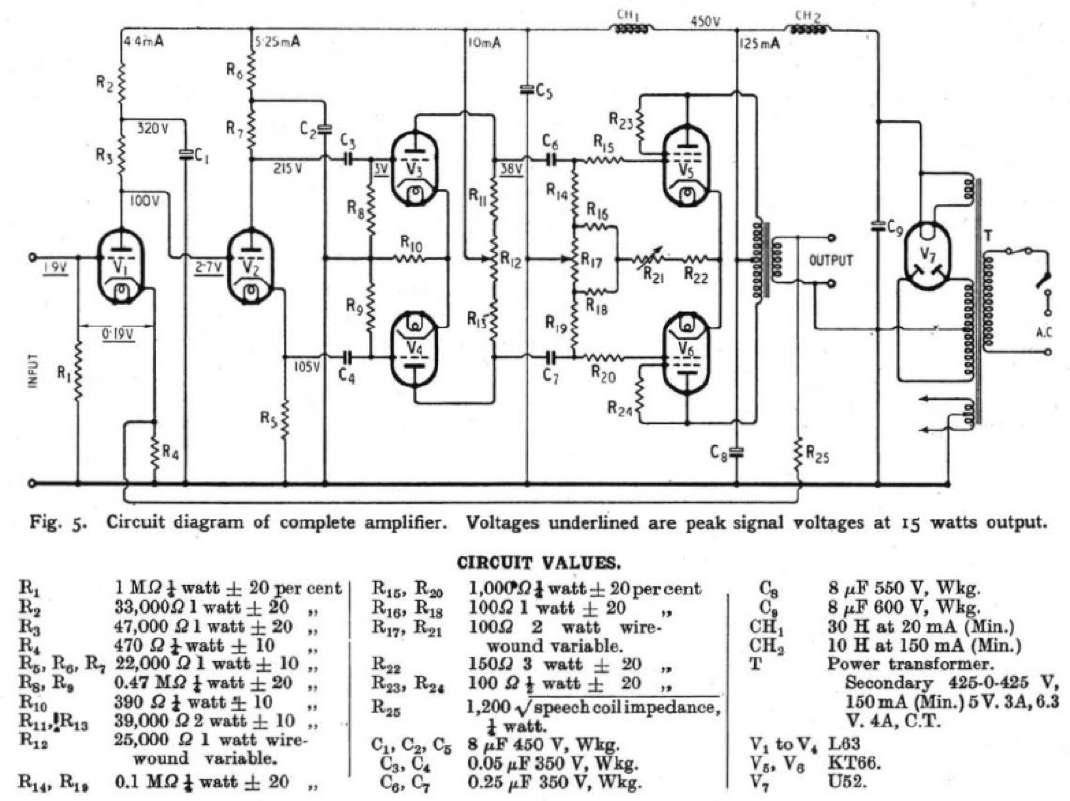
Figure 1 shows the circuit diagram for the early version. You will see the use of L63 triodes in the pre-amplifier stage and two KT66 valves in the output stage. (The KT in the valve's name stands for "kinkless tetrode", the kinkless bit being a reference to the shape of the value's performance curve, representing an effective way to circumvent the similar improvement in response recently patented for pentode valves.) 'The rectifier valve was a U52. In summary, it is a four-stage, Class A triode design using deep global negative feedback (20 dB) and a push-pull typology for the output tubes. The fact it was a four-stage design is important because an additional amplification stage was required to recover the input sensitivity lost due to the use of the global feedback. A push-pull typology using triode valves was considered in the 1940s to be the optimal basis for the design of a high-quality audio amplifier (notwithstanding the triode's chief drawback, high input capacitance).
The Williamson amplifier is significant in audio design, and this is because it eliminated the multiple inter-stage transformers that had been widely used in earlier designs and it DCcoupled the first two stages, both innovations being critical in minimising phase shifts. Williamson recognised it was vital to keep phase shifts to a minimum with a push-pull, negative-feedback design, given that the output transformers were integral to the global negative-feedback loop. The transformers therefore had to be of exceptional quality, otherwise they would be responsible for introducing large shifts in phase at frequency extremes. Were these to develop, what was intended to be a global negative feedback loop would quickly morph into a global positive feedback loop. The amplifier would then become a massive oscillator - with disastrous results for your speakers.
The well-known and respected English transformer maker Partridge Transformers Ltd was responsible for building the output transformers. The primary required 4,400 turns, the windings divided into ten primary and eight secondary sections and as by Lankshear (1990) noted "all interleaved into two balanced halves." They must have cost a fortune to make, and the highlight the deep skill-base of the English audio industry immediately after WW2. Negative feedback was optimised at 20 dB, and levels greater than that, Williamson concluded, served little or no useful purpose.
By demonstrating an Australian-made amplifier of the time that used slightly smaller transformers than those developed by Partridge, Tim and Ric showed just how essential high-quality transformers were to the Williamson design. The single most critical component in any valve amplifier is the output transformer, and as Tim and Ric noted, these are the single biggest cost in a valve amplifier, commonly accounting for at least a third of the total. In this situation there will always be a financial incentive to use cheaper transformers, i.e. ones that are smaller, lighter, less complex, or use lower quality wiring or non-grain-orientated steel in the transformer core. Tim and Ric showed plots of output power and phase shift of the Australian model to show how the amplifier with the smaller transformers had a markedly poorer performance than one with the big, expensive Partridges. It was still a good amp, just not as good as the original design would allow had better (i.e. dearer) transformers been used.
The Williamson amplifier is astonishingly significant in audio history because through it Williamson proposed - and then implemented - a set of design specifications that still hold today. Slightly later than its 1947 debut,
Williamson collaborated with Peter Walker (of QUAD fame) on an article published in a 1952 issue of Wireless World that expanded upon these requirements: Total non-linear distortion (i.e. harmonic and intermodulation) should be less than 0.1% at all power outputs (1-2 % was typical for the time) Linear frequency response within the audible spectrum of 10 Hz to 20 kHz Frequency response should be better than -3 dB at 3 Hz and 60 kHz, in order to minimise phase shifts through the audio bandwidth (40 Hz to 10 kHz + 1 dB was typical at the time) Phase shifts within the entire audio bandwidth should be less than 20o, in order to prevent the amplifier becoming an electronic oscillator Good transient response, with a power supply sufficient to accommodate large dynamic peaks in the music Output impedances as low as possible, and always "much less" than the speaker impedance, in order to provide adequate electric damping and limit undesirable peaks in the bass response of the speaker Hum and noise at least 80 dB below the maximum output. They concluded (p. 357) that this was "a formidable specification, and by no means every amplifier styled as "high quality" will meet it."
Nevertheless, specifications as tight as these were required because of the very great advances in recording quality that had been made in the late 1940s. An example is the introduction in June 1948 by Columbia Records of the 33 1/3 rpm microgroove LP record; until then, far looser specifications for frequency range etc were acceptable as they were sufficient for the shellac 78s and (AM) radio broadcasts that then made up all the program material. Greg Milner, in his 2009 book Perfecting sound forever: the story of recorded music, showed the degree to which recording processes had been improved after WW2 (e.g. as seen in Decca's FFRR records), microphones and speakers had become much better as a result of wartime technical developments in sonar etc, FM radio broadcasts (invented in 1933 but first provided in 1948 in New Jersey), and tape recorders using high-frequency bias (a wartime invention in Nazi Germany by AEG) were just coming onto the market (e.g. the Americanmade Ampex Model 200 in 1948). What an exciting period it must have been for those interested in music reproduction in the late 1940s and early 1950s!
To conclude - we heard last month an amplifier that was designed in 1947, teamed with speakers that first saw the light of day in 1961. In other words, an amplifier from eight decades ago and speakers from six decades ago. What glorious music they made, and made on track after track after track, regardless of genre or period of recording. What perfect, unbridled pleasure they provided. And the track that stood out for me - Elvis' "Can't help falling in love" - was recorded back in 1961 too. In other words, at the same time the Leak speakers were introduced and thus also over six decades ago, recorded using valve microphones and mono valve tape recorders and valve mixing desks etc, etc, etc. Yet we are told relentlessly by audiophile manufacturers that "new is best", that the most recent amplifier and speaker designs are light years ahead of what was claimed as first-class only a few months ago, that only modern 196 kHz 24-bit recordings will do as sources, that we need at least 24, preferably 36, speakers in our living/music/ theatre room to obtain the best sound, and this must include at least six sub-woofers.
Rubbish to all that self-serving baloney. The Williamson amplifier/Leak speaker combination is a superb corrective to the debilitating audiophile disease of upgradism. It makes beautiful music and what our hobby is about is music, not which amplifier has 0.000000001% total harmonic distortion at 2 Hz at a rated output of 3 kW per channel. It provides a remarkable antidote to the Cult of the New. Thus my new credo: "Long live audio 'anachronisms'!"
Further reading:
Frankland, S. (1996). Single-ended vs pushpull. Part 1. Stereophile 19 (12): 110-121.
Lankshear, P. (1990). The Williamson amplifier. Electronics Australia July 1990: 150-153.
Milner, G. (2009). Perfecting sound forever: the story of recorded music. Granta, London. Popovich, I.S. (2016). Audiophile vacuum tube amplifiers. Volume 3. Self-published, Perth.
Stinson, P.R. (2020). The Williamson amplifier of 1947. Available online at: https://dalmura.com.au/static/The%20Williamson%20Amplifier%20History.pdf
Williamson, D.T.N & Walker, P.J. (1952). Amplifiers and superlatives: an examination of American claims for improving linearity and efficiency. Wireless World September 1952: 357-361.
Paul Boon
| January 2025 | Steve Van Sluyter from SpectraFlora |
It was at the 2024 StereoNET Hi-Fi and AV
Show that I met Steve and had the privilege to
listen to his SpectraFlora Celata 88 speakers,
which were enjoyed by myself and many other
discerning punters at the show. As a result, I
was particularly pleased when I learned that
he accepted my invitation to present these
speakers to our club in the Willis Room!
At $35,000 a pair without optional extras such
as stands or special timber, I recognised that
their appeal to the club could be somewhat
limited due to their asking price, but what
makes our General Meetings so great is the
chance to hear some very special equipment
that is potentially far beyond the price range of
our members (myself included), and these
speakers were definitely no exception.
One of the features that Steve was particularly
proud of was the Celata 88's Dynamic
Waveguides, which were specially-optimised
horns designed to combine the benefits of
traditional horn tweeters with those of a
waveguide. I won't go into detail about the
exact technology that went into their
creation. Steve explains it far better than I can
on his newly-revamped website which I'll link
at the bottom of this article.
For the presentation, the Celata 88s were
paired with a Gustard R26 DAC, an Audio
Research Reference 1 preamp and a Parasound
A21 power amp, the same setup with which
Steve normally
showcases his
speakers (including
the StereoNET show).
The results in the
Willis Room, which is
notoriously difficult
for good acoustics,
were nothing short of
spectacular, and many
club members that I
spoke to were also
very impressed with
Steve's presentation.
The carefully-curated
musical playlist for the
evening was also notable, combining classical
pieces from composers such as Bach, Dvooak
and Chopin with a variety of other selections
from artists including Elton John, Ella
Fitzgerald, David Bowie, Pearl Jam and Keith
Jarrett, to name but a few.
Many thanks to Steve and his partner for being
kind enough to travel all the way from
Inverleigh to present to us.
Website: www.spectraflora.com.au
Bailey White
MAC Editor